Most visitors drive straight through Llanrwst on their way to Betws-y-Coed. That’s a mistake.
This is where locals actually shop. Where Welsh is the first language in the bakery queue. Where a 15th-century courthouse serves cream teas beside a bridge that’s been carrying traffic since 1636.
Llanrwst doesn’t polish itself up for tourists, it doesn’t need to. For centuries, it’s been the market town at the heart of the Conwy Valley, the undisputed capital of this stretch of Welsh countryside. Visit Conwy calls it exactly that: the capital of the Vale of Conwy.
The town’s own motto makes the point with characteristic Welsh bluntness: Cymru, Lloegr a Llanrwst: Wales, England and Llanrwst. That isn’t modesty. It comes from a time when the town sat so fiercely on the border between the two kingdoms, so stubbornly independent, that locals considered it a third entity altogether.
That attitude hasn’t entirely gone away.

What to See and Do in Llanrwst
If Betws-y-Coed is the gateway to Eryri (Snowdonia), Llanrwst is the living room.
You won’t find adventure sports or outdoor gear shops here. Instead, you’ll discover a real Welsh market town with independent butchers, traditional bakeries, a proper deli and layers of history tucked into quiet corners.
It sits on the River Conwy, right on the A470. If you’re staying with us, Llanrwst is your local town, about 15 minutes down the valley, and the place we send guests when they need to stock up, stretch their legs or simply experience somewhere that isn’t performing Welshness for anyone’s benefit.
The Icon: Pont Fawr Bridge
Walk through Llanrwst and Pont Fawr waits for you at the far end of town, where the high street gives way to the river.
This steep, three-arched stone bridge dominates the town centre, rising dramatically over the River Conwy. Built in 1636 and funded jointly by the counties of Caernarfonshire and Denbighshire, it’s been carrying traffic for nearly 400 years. The design is often attributed to Inigo Jones, though historians continue to debate this.
It’s narrow – so if you’re driving over it, go slowly and hope you don’t meet anything coming the other way. If you’re walking, stick to the pavement and watch your step; the camber is steep enough that you’ll feel the incline in your calves.
But it’s worth every step. The pale stone catches the western light in the afternoon. Walk to the far bank and all three arches reflect cleanly in the water when the river’s calm. It photographs well from almost any angle, but the south bank gives you the full span with the hills behind.
Pont Fawr – Visiting Information:
- Location: Town centre – you can’t miss it
- Walking: Free to walk across (take care on the narrow pavement)
- Parking: Glasdir car park, just before the bridge coming from Betws-y-Coed
- Best Photo Spot: From the riverside walk on either bank

Tu Hwnt i’r Bont: The Tearoom Everyone Photographs
Cross Pont Fawr and on the far side sits a small white cottage covered in Virginia Creeper. This is Tu Hwnt i’r Bont, which translates as “Beyond the Bridge.”
Built as a courthouse in the 15th century, it’s now a National Trust tearoom, and it’s one of the most photographed buildings in North Wales. That Virginia Creeper turns vivid crimson in autumn, transforming the white cottage into something from a postcard.
Inside, you’ll find low ceilings, exposed beams and stone walls. The scones are excellent, and the atmosphere is cosy without being twee. Get there early if you can. By lunchtime in summer and autumn, you’ll be queuing out the door.
Tu Hwnt i’r Bont – Visiting Information:
- Location: Immediately across Pont Fawr from the main town
- Opening: Seasonal hours (typically March-October; weekends only in winter – check National Trust website)
- Peak Time to Visit: Late September/October for the red ivy
- Parking: Use Glasdir car park and walk across the bridge (5 minutes)
- Dog-Friendly: Outside seating only

St Grwst’s Church and the Gwydir Chapel
Walk five minutes from Pont Fawr up towards the town square, and you’ll reach St Grwst’s Church. Most people walk straight past. Don’t.
Attached to the church is the Gwydir Chapel, and inside that chapel sits the stone sarcophagus of Llywelyn the Great, Prince of Wales.
This isn’t a replica. This is the actual 13th-century coffin, rescued from Maenan Abbey after the Dissolution of the Monasteries and brought here by the Wynn family of Gwydir Castle in the 16th century. It’s empty now (Llywelyn’s remains were lost centuries ago) but standing in front of it is a powerful experience. This coffin has survived Aberconwy Abbey, Maenan Abbey and finally Llanrwst, protected because people understood it mattered.
Standing here, it is a reminder of the area’s defiant history. Llywelyn the Last, grandson of Llywelyn the Great, is traditionally credited with declaring Llanrwst a ‘free borough’ in the 13th century. While his death in 1282 marked the end of an era for Wales, the town’s sense of independence remained a defining part of its identity for centuries.
The Gwydir Chapel itself is remarkable, with ornate 17th-century painted ceilings, carved woodwork and memorials to the Wynn family who dominated this area for generations. The chapel is sometimes locked, but if you ask at the church, staff will usually open it for you.
St Grwst’s Church – Visiting Information:
- Location: Town centre, short walk from Pont Fawr
- Opening: Church usually open daily; Gwydir Chapel may need unlocking (ask inside)
- Entry: Free (donations welcome)
- Time Needed: 20-30 minutes
- Parking: Market Square (limited) or Glasdir car park (5-minute walk)

Where to Shop: The Essentials
If you’re self-catering, and if you’re staying with us, you are – Llanrwst has everything you need. These are the places we shop ourselves.
Blas Ar Fwyd
One of the best Welsh delis and wine merchants in North Wales. The cheese counter alone is worth the trip: Welsh cheddars, Y Fenni with mustard seeds, Perl Wen, Perl Las, plus imports from across Europe. The deli counter stocks local charcuterie, olives and preserves. The wine selection is carefully chosen, and the hampers make excellent gifts.
It’s also a place where locals shop. You’ll hear as much Welsh as English, and the staff know their products inside out. If you’re planning a special dinner at the cottage, this is where to buy the ingredients.
Need to Know:
- Location: High Street, Llanrwst town centre
- Opening: Check website for current hours (closed Sundays)
- What to Buy: Welsh cheese, local preserves, wine, hampers

Scilicorns Bakery
A proper Welsh bakery that’s been serving the town for decades. The smell alone will pull you in from the street.
Come early for the best selection: fresh bread, Welsh cakes, bara brith, pastries and pies. Everything is baked on-site using recipes handed down over three generations. Prices are reasonable, quality is consistently excellent.
If you’re planning a picnic before a walk in Gwydir Forest or need breakfast supplies for your cottage, this is your first stop.
Need to Know:
- Location: High Street, Llanrwst town centre
- Opening: Early morning start (closed Sundays)
- What to Buy: Fresh bread, Welsh cakes, bara brith, pies
A. L. & R. O. Jones Butchers
A traditional Welsh butcher where locals have been buying their meat for generations. Excellent quality Welsh lamb and beef, proper sausages, bacon and everything you need for a cottage barbecue. If you’re planning to cook at your cottage, this is where to source your ingredients.
Need to Know:
- Location: High Street, Llanrwst town centre
- Opening: Standard shop hours (closed Sundays)
- What to Buy: Welsh lamb, beef, sausages, bacon
Parking for all: Market Square or Glasdir car park, both within easy walking distance
Tuesday: Llanrwst Market Day
If you’re here on a Tuesday, you’ll see Llanrwst at its most authentically Welsh.
The livestock market has been running for generations. This isn’t a tourist attraction – it’s where local farmers come to buy and sell sheep and cattle, where deals are done in Welsh over coffee and where Land Rovers fill the car parks. You’ll hear the auctioneer’s rapid-fire Welsh, smell livestock and see the valley’s agricultural heritage still very much alive.
In the town centre, there’s a small farmer’s market on Ancaster Square where local producers sell vegetables, eggs, baked goods and crafts. It’s modest and genuine, people shopping here are buying for their kitchens, not souvenirs.
Tuesday in Llanrwst isn’t polished or packaged. It’s a Welsh market town being exactly what it’s been for centuries. That’s worth experiencing if your dates align.
The Riverside Walk
Llanrwst sits on the River Conwy, and there’s a lovely flat riverside walk that starts near Pont Fawr and follows the water downstream.
It’s an easy stroll, mostly on boardwalk and surfaced paths, suitable for all abilities. You get views back to the bridge, across to the wooded hills and along the river as it curves through the valley. Walk as far or as little as you like. On a summer evening, it’s perfect for stretching your legs after dinner. In autumn, the trees along the riverbank turn golden.
The walk also connects to paths that lead into Gwydir Forest Park, if you’re feeling more adventurous.
Need to Know:
- Start Point: Near Pont Fawr, access from Glasdir car park
- Difficulty: Easy, flat, mostly surfaced
- Time: 30 minutes to an hour (turn back when you like)
- Dog-Friendly: Yes, on lead near livestock

Getting to Llanrwst
Llanrwst is located right on the A470, the main road through the Conwy Valley. From our cottages, it’s about 15 minutes south. From Conwy town, it’s 25 minutes. From Betws-y-Coed, it’s 8 minutes north.
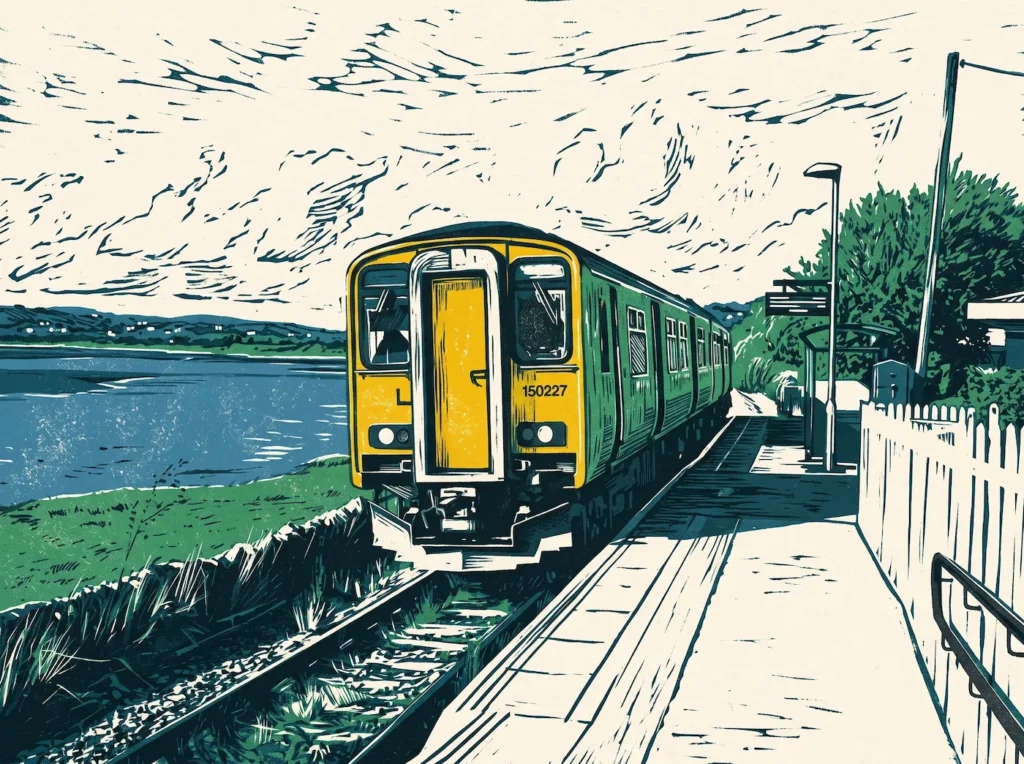
If you’re using public transport, Llanrwst has a station on the Conwy Valley Railway line, with regular trains from Llandudno Junction through to Betws-y-Coed and Blaenau Ffestiniog. The station is a short walk from the town centre.
Parking:
- Glasdir Car Park: The main car park, just before Pont Fawr coming from the south. Usually has spaces even when Betws-y-Coed is rammed. Pay-and-display.
- Market Square: Smaller, closer to the town centre, but limited spaces.
Why We Send Guests Here
After years of hosting, we recommend Llanrwst to every guest who wants to experience a real Welsh market town. It’s not trying to be picturesque – it just is. The history isn’t packaged into a visitor centre; it’s built into the fabric of the place. The bridge you drive over. The church you walk past. The tearoom you stop in for scones.
And practically, it’s useful. The Glasdir car park rarely fills up, the shops sell things you actually need and the deli, butchers and bakery stocks your cottage with quality ingredients. It’s 15 minutes from us, which makes it ideal for a morning coffee run, a market day wander, or an afternoon out when you don’t want to commit to a full day’s driving.
If Betws-y-Coed is North Wales for tourists, Llanrwst is North Wales for people who live here. And that’s exactly why it’s worth your time.

And when you’ve had your fill of the valley floor, the views from our cottages put everything in perspective – the Carneddau range spread out above the treeline, the river cutting through below. Llanrwst is 15 minutes down the hill.
FAQs
How do you pronounce Llanrwst?
“Thlan-roost.” The initial “Ll” is that distinctive Welsh sound, a soft “th” with a bit of breath behind it (like blowing out a candle while saying “th”). The “r” is rolled. Don’t worry if you don’t get it perfect; locals appreciate the effort and will gently correct you if needed.
Is Llanrwst worth visiting?
Absolutely, especially if you want history, excellent food shops and a quieter alternative to Betws-y-Coed. It won’t take a full day, but it pairs well with other valley activities. Spend a morning here, then head to Gwydir Forest for a walk or combine it with a trip to Bodnant Garden.
When is the best time to see the red ivy at Tu Hwnt i’r Bont?
Late September through October is peak colour for the Virginia Creeper. It starts turning in mid-September and reaches full crimson by early October. By late October, the leaves begin to fall. Morning light is particularly good for photographs.
What is Llanrwst’s famous motto?
Cymru, Lloegr a Llanrwst: Wales, England and Llanrwst. It dates from the 13th century, when the town sat so defiantly on the border between Welsh and English territory that locals considered it a third entity altogether. The motto has been adopted by a local band and is still used with pride today.
Some images: © Crown Copyright